Maryland · Heating Oil Tanks · State Funding
Maryland Oil Tank Removal Reimbursement: The Program Is Closed. Here's What to Do Now
Short answer
No. Maryland's Residential Heating Oil Tank System Site Rehabilitation Reimbursement Program is closed. MDE accepted applications through July 1, 2024, and approved applicants had until December 31, 2024 to submit expense forms. Even when it was open, it reimbursed cleanup of a heating oil leak, not the cost of removing a sound tank, and never the cost of closing a tank in place. If you have a tank to deal with now, plan to pay for the removal yourself and compare quotes from Maryland-certified removers.
Status checked November 23, 2026: MDE's Residential Heating Oil page lists the program as “CLOSED.”
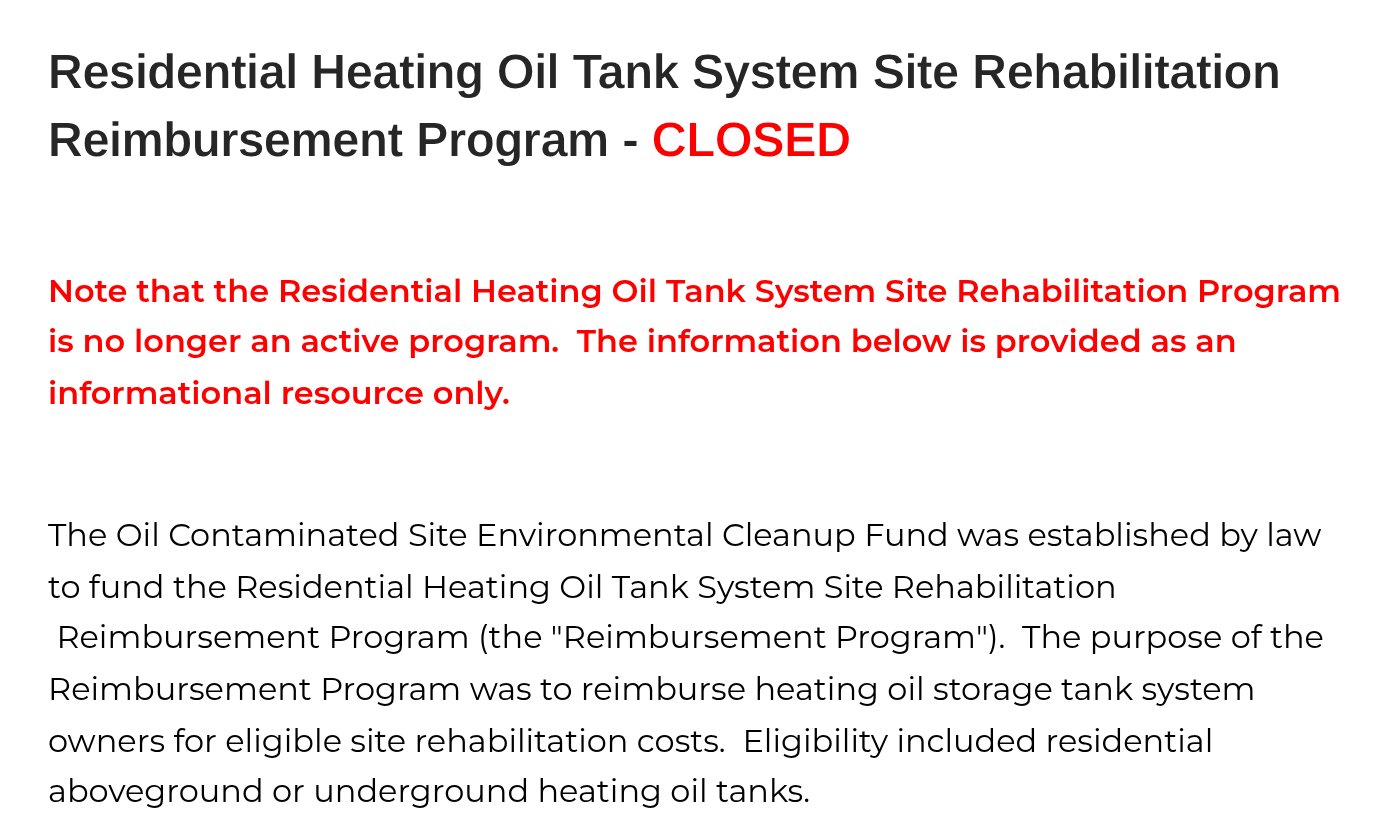
Is There Still a Maryland Oil Tank Reimbursement Program?
No. MDE's own wording is that the Residential Heating Oil Tank System Site Rehabilitation Program “is no longer an active program” and that the information it still publishes about it is “provided as an informational resource only.”
The end date comes from the statute. Maryland Environment Article §4-705(b)(2) says that “until June 30, 2024,” a residential owner of a heating oil tank may apply to the Fund for reimbursement. MDE explains that because June 30, 2024 fell on a Sunday, state law moved the effective deadline to July 1, 2024. Applications also had to arrive within 6 months of finishing the cleanup work.
MDE's report on the Oil Contaminated Site Environmental Cleanup Fund for fiscal year 2025 (July 1, 2024 through June 30, 2025) shows what happened next: MDE received 3 residential applications, denied all 3 for ineligible activities, and states plainly that “in FY25, MDE did not reimburse any residential applications.” The same report lists an available fund balance of $65,532.04 at the end of FY25.
I applied before July 1, 2024. What now?
MDE says an applicant with a complete application received by July 1, 2024 could still be reimbursed for eligible expenses after that date, but every reimbursement request had to arrive within 6 months of completing the work, which gave approved applicants until December 31, 2024 to submit an expense form. If you have a question about an application that was already in the system, call MDE's Oil Control Program directly at (410) 537-3442. We can't tell you anything about the status of an individual file, and nobody else can either.
What the Program Covered While It Was Open (and What It Never Did)
This is history now, but it matters if you are reading an older article or an old quote that assumes the state will pay. The program paid for site rehabilitation, meaning cleanup after oil got out. The lists below summarize COMAR 26.10.14.05, the regulation that defined eligible and ineligible costs.
Could be reimbursed
- Excavation, transportation and proper disposal of oil-contaminated soil, or on-site treatment such as soil vapor extraction
- Buying and installing groundwater remediation equipment
- Subsurface investigation, well bailing, recovery system design, operation and monitoring
- Replacing a private supply well
- Odor abatement, such as forced venting and removing oil-saturated materials so the home is habitable again
- Removing the tank, but only if MDE decided removal was necessary to treat the contaminated soil
Never reimbursed
- Closing an underground residential heating oil tank in place
- Installing a new or replacement heating oil tank
- Contractor mobilization and demobilization of equipment, materials and crew
- Preparing the application and gathering its paperwork
- Work not related to cleaning up oil-contaminated soil, groundwater or surface water
The limits sat in COMAR 26.10.14.08 and §4-705(c) of the statute. Each approved occurrence carried a $500 deductible and a $20,000 maximum. For applications received on or after July 1, 2022, the share also depended on the property's value:
- Property worth $300,000 or less: 100% of eligible costs, up to $20,000 less the $500 deductible.
- Over $300,000 up to $600,000: 50% of eligible costs, up to $10,000 less the deductible.
- Over $600,000: 25% of eligible costs, up to $5,000 less the deductible.
The statute also excluded the cost of replacing or retrofitting tanks and piping (§4-705(g)). In other words, a homeowner who simply wanted an old, non-leaking buried tank out of the yard before a sale was never the person this program was written for.
Why You Still See “Maryland Reimburses Tank Removal” Online
COMAR 26.10.14 is still published, and it reads like a live program: application steps, eligible costs, reimbursement caps. The closing date lives in the statute, not in that regulation, so someone reading only the regulation would not see it. Many contractor and information pages were also written before 2024, when the program was being extended every few years (MDE's report traces extensions in 2017, 2019 and 2021). Check the date on anything you read, and when in doubt, go by MDE's Residential Heating Oil page.
Is Any Other State Money Available?
We did not find any open Maryland program that pays a homeowner to remove or clean up a residential heating oil tank. If you think one may apply to you, ask MDE's Oil Control Program before you plan around it.
The places worth checking are private ones. Read your homeowner policy, and any separate tank policy you or your oil company may have, for what it says about oil releases; our oil tank insurance claim guide explains what to ask your agent. To spread the cost of a removal, see oil tank removal financing options, and for how other states handle this, our state-by-state reimbursement program guide.
What Maryland Requires When You Stop Using an Oil Tank
The money is gone, but the rules are not. MDE's Residential & Farm UST Closure fact sheet (July 2024) says that once an underground tank at a home or farm is no longer used to store fuel, State law requires it to be removed or closed in place. Closing in place is recommended only when the tank is under a building or removing it would endanger the building's structure.
Residential underground tanks of 1,100 gallons or less are exempt from most of Maryland's oil control regulations, but not from the closure requirements in COMAR 26.10.10. MDE says its Oil Control Program does not require prior notice of these closures, and that removal must be performed by an MDE-certified technician or remover. Tanks over 1,100 gallons follow stricter closure rules and must be registered.
Aboveground and basement tanks are different. MDE's residential AST fact sheet says the department does not regulate the closure of residential heating oil aboveground tanks and a certified UST remover is not required, though State law still requires removal once the tank is no longer used, and MDE recommends a contractor familiar with heating oil equipment.
The closure steps for a buried tank, from MDE's fact sheet
- 1
Tell your oil company
If you are converting to gas, electric or a heat pump, or replacing the tank, MDE’s fact sheet says to call your oil distributor so deliveries stop.
- 2
Hire a Maryland-certified remover
Underground tanks must be closed under the on-site supervision of an MDE-certified UST System Technician or Remover. Check the name on MDE’s certification search before you sign.
- 3
Pull any local permit
Before excavation, a permit to remove or abandon the tank may be required by the local fire, health or planning department. Your contractor normally knows which office applies in your county.
- 4
Empty, clean and remove (or fill in place)
All oil comes out of the tank and lines, the tank is cleaned of liquid and sludge, and piping, the fill pipe and above-ground vent come out. Closing in place means filling the tank with a solid inert material such as sand or cement slurry; MDE says foam is not acceptable.
- 5
Sample the soil
For removal, post-excavation soil samples; for closure in place, samples from at least 2 feet below the tank bottom. MDE specifies VOCs (including fuel oxygenates and naphthalene) by EPA Method 8260 and TPH-DRO and TPH-GRO by EPA Method 8015.
- 6
Backfill and keep the paperwork
Excavations are backfilled with clean material. Keep the closure documentation, lab results, photos and disposal receipts together. A future buyer, lender or insurer is likely to ask for them.
For more on permits and county practice, see our Maryland MDE oil tank removal requirements guide, plus the service pages for underground tank removal in Maryland and closing a tank in place in Maryland.
No state money, but you can still compare quotes
Tell us your ZIP code, whether the tank is underground or aboveground, and your timeline, then compare written quotes from tank removal contractors serving your area.
Get free quotes →If the Contractor Finds a Leak
MDE's fact sheet says you and the contractor must report any contamination of soil or groundwater found during a removal or closure to MDE “immediately, but not later than 2 hours” after discovery: (410) 537-3442 during work hours, or 1-866-633-4686, MDE's 24-hour spill line, after hours. Contaminated soil is excavated to the maximum extent practicable and sampled again to document the cleanup.
Treat removal and cleanup as two separate jobs with two separate scopes. A removal quote covers getting the tank, the oil and the piping out and sampling the soil. If sampling shows a release, the remediation scope depends on what the lab finds, so it usually can't be priced until then. Ask each contractor how they handle that change: who reports it, who decides how much soil comes out, and how extra work is billed.
See soil remediation in Maryland for what the cleanup side involves.
What a Maryland Removal Costs Now That There's No Fund
Without a state program, the homeowner pays for the removal. The price is set by the job, not by the state: whether the tank is buried or in the basement, its size and depth, how much oil and sludge are left in it, access for equipment, whether the driveway or a patio sits over it, the local permit, the soil sampling, and whether a release is found. The only reliable number is a written quote for your property, itemized so you can see what is and isn't included. Our Maryland oil tank removal cost guide walks through those cost factors in more detail.
Find a Certified Remover Near You
Start with your area, then confirm every name on MDE's certification search (linked from the Residential Heating Oil page) before you sign anything for an underground tank.
- Oil tank removal in Glen Burnie
- Oil tank removal in Columbia (Howard County)
- Oil tank removal in Baltimore
- Oil tank removal in Annapolis
- Oil tank removal in Towson
- Oil tank removal across Maryland
For named firms, see our sourced list of the best oil tank removal companies in Maryland. Not sure there is a buried tank at all? Start with a tank sweep in Maryland.
Frequently Asked Questions
Is there a reimbursement program for oil tank removal in Maryland?
No. MDE marks the Residential Heating Oil Tank System Site Rehabilitation Reimbursement Program as closed and says it is no longer an active program. MDE accepted applications through July 1, 2024, and approved applicants had until December 31, 2024 to submit expense forms. Even when it was open, it did not pay to remove a sound tank.
Did Maryland's heating oil tank cleanup fund close?
The residential reimbursement program it paid for did. The statute let homeowners apply only until June 30, 2024 (MDE took applications through July 1, 2024 because June 30 was a Sunday). MDE's FY2025 report says it received 3 residential applications that year, denied all 3 for ineligible activities, and reimbursed no residential applications.
Does Maryland pay to remove an underground oil tank that isn't leaking?
No, and it never did. The program reimbursed site rehabilitation after a leak. Under COMAR 26.10.14.05, tank removal counted only when MDE decided removal was necessary to treat contaminated soil. Closing a tank in place, installing a replacement tank and contractor mobilization were listed as ineligible.
What did Maryland's residential heating oil tank reimbursement program cover?
Cleanup of a heating oil release: excavating, hauling and disposing of contaminated soil or treating it on site, groundwater remediation equipment, investigation and monitoring, private well replacement and odor abatement. Approved applications had a $500 deductible and a $20,000 cap per occurrence, with lower percentages and caps for higher-value homes on applications received from July 1, 2022.
Who can remove an underground oil tank in Maryland?
MDE says residential and farm underground tanks, including those of 1,100 gallons or less, must be closed under the on-site supervision of a Maryland-certified UST System Technician or Remover. MDE's website has a certification search to confirm a contractor. Contamination found during the job must be reported to MDE within 2 hours of discovery.
Does MDE need to be notified before a residential tank removal?
For a residential underground tank of 1,100 gallons or less, MDE says its Oil Control Program does not require prior notice of the closure. A local permit may still be required by your fire, health or planning department, and tanks over 1,100 gallons follow stricter rules and must be registered with MDE.
Get quotes from Maryland-certified tank removers
Free to request. Tell us your ZIP, tank type and timeline, and compare itemized written quotes.
Get free quotes →Sources
- Maryland Department of the Environment, Residential Heating Oil (program status, deadlines, 1,100-gallon rule, certification search)
- Maryland Code, Environment §4-705 (application end date, deductible and cap, excluded costs)
- COMAR 26.10.14.05, Site Rehabilitation Costs
- COMAR 26.10.14.08, Reimbursement Limits and Deductibles
- MDE, Oil Contaminated Site Environmental Cleanup Fund report, FY2025
- MDE, Residential and Farm Underground Storage Tank Closure fact sheet (July 2024)
- MDE, Residential Heating Oil Aboveground Storage Tank Removal fact sheet (July 2024)
- Image: screenshot of the MDE Residential Heating Oil page, captured November 23, 2026.