Oil Tanks · Supply Lines & Leak Prevention
Heating Oil Line Leak? Sleeves, Oil Safety Valves and When the Tank Should Go Too
Most people picture a heating oil leak as a rusted-out tank. In a lot of basements the problem is the thin line that carries oil from the tank to the burner, buried in or under the floor where nobody has looked at it since the house was built. Here is why those lines fail, what the two standard fixes are, what three oil-heat states require, and how to get the line, the tank and any cleanup priced in one visit.
Quick answer
Unprotected copper or steel oil lines that touch concrete or soil corrode and crack, and Massachusetts DEP names the delivery line as the culprit in most home heating oil leaks it sees. The fix is either a new line inside a continuous non-metallic sleeve or a listed oil safety valve at the tank end, and Massachusetts law (M.G.L. c. 148, s. 38J) requires one or the other for most oil-heated 1- to 4-unit homes. If your tank is old, get the tank priced in the same visit. Compare licensed contractors through Get Quotes.
Why the Line Fails Before the Tank Does
Massachusetts DEP’s homeowner guide to delivery lines is blunt about it: in most of the home heating oil spills and leaks it handles, the culprit is the supply line that carries #2 fuel oil or kerosene from the tank to the burner. In older homes those lines were often buried in the ground or set within or beneath the basement slab, and they are usually copper, steel, brass or iron.
Two things go wrong. Metal in direct contact with soil, concrete and water corrodes until it springs a pinhole. And when the floor, the foundation or the soil under it shifts or settles, a rigid line embedded in it can crack. Either way the leak is under the floor, not on it. DEP notes that because older lines are neither visible nor encased, leaks can continue undetected for years, with oil moving into the soil under the house and eventually toward groundwater.
That is why a line leak can be a bigger job than a tank leak you catch early. Oil that drips from a tank fitting onto a sealed floor is visible and mostly reachable. Oil that leaves a buried line goes where you cannot see it, and the cleanup follows it. If you already have oil on the floor, start with our guide to a heating oil spill in the basement and come back to this page once the immediate problem is handled.
Signs Your Supply Line Is the Problem
- An oil smell in the basement with no visible drip at the tank, filter or burner.
- A dark stain or damp patch on the slab along the path between the tank and the burner.
- The line disappears into the concrete, or into a patched channel in the floor, and comes back up near the burner.
- Oil use that seems high for the weather, or the burner losing prime and needing service more often.
- Oil showing up in a floor drain, sump pit or crack in the slab.
None of these proves a line leak on its own. A licensed oil burner technician can check the system, and if soil under the floor may be affected, an environmental contractor can sample it. What you want to avoid is replacing the line, closing the floor back up and never finding out whether oil reached the soil.
The Fixes, Side by Side
There are only a few standard ways to stop a supply line from becoming a leak. Your technician will recommend one based on where the tank and burner sit and what your state’s code accepts.
Non-metallic protective sleeve
A new supply line run inside a continuous plastic sleeve, so the metal never touches the slab or soil.
Best for: Lines that must cross or run under a floor to reach the burner.
Ask: Will the old line be abandoned in the floor or removed? Where do the sleeve ends terminate so a leak would show?
Oil safety valve at the tank
A listed valve at the tank end of the supply line that stops flow if the line breaks.
Best for: Systems where re-routing the line is impractical, or as an added layer with a new line.
Ask: Which valve model, and is it listed and installed per the manufacturer’s instructions?
Re-route the line overhead or along the wall
Run the line up from the tank and across joists or walls so nothing is buried or in contact with the floor.
Best for: Basements where the burner and tank can be connected without crossing the slab.
Ask: Does the new route meet your state’s oil burner code and clear any foot traffic?
Replace the tank and line together
New tank, new protected line, filter and fittings in one permitted job.
Best for: Old, rusty or weeping tanks, or tanks on unstable legs or blocks.
Ask: Is removal and disposal of the old tank, and pumping any remaining oil, in the price?
Massachusetts: The 38J Oil Line Upgrade
Massachusetts turned this into law. M.G.L. c. 148, s. 38J says an owner of residential property (a 1- to 4-unit dwelling) that uses a heating oil tank on the premises, with one or more supply or return lines in direct contact with concrete, earth or other floor surfaces, must do one of three things: enclose any fuel supply line in a continuous non-metallic sleeve, have an oil safety valve installed at the tank end of the supply line following the manufacturer’s instructions, or use another release prevention method the Board of Fire Prevention Regulations approves.
The law has two exemptions:
- The burner is located above the tank and the entire supply line is connected to, and above, the top of the tank.
- The supply lines or an oil safety valve were installed or upgraded on or after January 1, 1990, comply with 527 CMR 4.03 and 4.04, and have been inspected and certified by a licensed oil burner technician.
The inspection must be done by a licensed oil burner technician, who certifies compliant work on a Department of Fire Services form. The owner submits that certification to the head of the local fire department. State fire regulations also require new lines to be sleeved when installed, and replacement lines to be sleeved when a listed oil safety valve is not used.
The same law changed insurance. A state fact sheet explains that insurers writing homeowner policies must offer coverage for oil-heat leaks to homeowners whose systems are certified compliant or exempt: at least $50,000 of first-party cleanup coverage and at least $200,000 of third-party coverage, with a deductible no higher than $1,000 per claim. The coverage is optional to buy, so check whether your policy actually has it. Our Massachusetts oil tank removal guide covers the tank side of the same rules.
Line Work Coming Up? Price the Tank in the Same Visit
Tell contractors what you have, where the line runs and how old the tank is. Get removal, replacement and line work quoted together.
Get Free Quotes →Vermont and Maine Rules Worth Knowing
Vermont runs its heating tank rules through fuel deliveries. Under the Aboveground Storage Tank Rules, an inspector who finds certain problems must mark the tank noncompliant and “red tag” it, and a red-tagged tank cannot receive fuel until the problem is fixed. DEC lists fuel line protection among those items: buried fuel lines and tank piping must be coated or sleeved against corrosion, and for tanks installed after August 1, 2024, all fuel lines and piping in contact with earthen materials or concrete must be coated and sleeved against corrosion and crushing. The same list covers the tank foundation, the fill and vent pipes, general tank condition and, since August 1, 2024, plugging unused tank openings.
Maine’s Fuel Board rules for outside tanks focus on what can break a line from the outside. Outside tanks and piping must be located so they are not subject to falling snow or ice, with a protective cover over the tank valve, the oil filter and any piping that is not structurally supported or attached to the building. For a single-tank installation, the supply line may not extend more than twelve inches beyond the face of the tank. Existing outside tanks are held to the same standards as new ones, and old tanks must be disposed of under Maine DEP rules.
Elsewhere, the rules for residential heating oil lines usually sit in the state or local fire and mechanical codes, and the oil burner technician or fire official is the person who knows the local version. If you are in New Jersey, New York, Connecticut or Pennsylvania, our state guides list the agencies that handle tanks.
When the Tank Should Go Too
A line upgrade is a technician visit with a permit. So is a tank replacement. Doing both at once means one shutdown, one permit trip and one set of fittings, and it means the new protected line is connected to a tank you trust. It is worth pricing the tank alongside the line when:
- The tank shows rust, scaling or wet spots on the bottom or at the seams, or weeps at fittings.
- The legs are corroded or the tank sits on an uneven or crumbling base.
- You do not know how old the tank is, or it predates the current owners.
- You are planning to switch to gas or a heat pump in the next few years anyway.
- There is an old buried tank on the property that was replaced by a basement tank and never closed.
If you are leaving oil, the order matters: keep the oil system working until the new heat is installed and running, then have the tank pumped out, the line and tank removed, and the fill and vent pipes taken off the outside wall. Our guide to replacing an oil tank vs. removing it for good walks through that decision.
If the Line Has Already Leaked
A leak changes the job from an upgrade to a release. In Massachusetts, DEP regulations at 310 CMR 40.0000 require oil releases to be cleaned up to set standards on set timelines, which can mean excavating contaminated soil, and releases of ten gallons or more must be reported to DEP within two hours. Other states have their own spill reporting rules and hotlines. The order of operations is roughly the same everywhere:
- Stop the flow: shut the tank valve if it is safe, and call your oil company or a licensed technician.
- Report it if your state requires, and tell your insurer early.
- Have the line replaced or protected so the source is gone.
- Let an environmental contractor assess the floor and soil before the slab is patched.
- Keep every invoice, report and permit together for a future sale.
Insurance is where many owners get surprised. DEP’s guide says most homeowner policies do not cover leaking tank systems or environmental cleanup. Our article on oil tanks and homeowners insurance covers what to ask your agent.
How to Get One Quote That Covers Everything
Line work, tank work and cleanup are often done by different licenses, and that is how scope falls through the cracks. Send every contractor the same package and ask for each item as its own line:
- Photos of the tank, the filter, where the line enters the floor and where it comes up at the burner.
- The tank size and approximate age if you know them, and whether the tank is indoors or outside.
- Whether you want the line sleeved, a safety valve added, the line re-routed, or the tank replaced or removed.
- Whether the existing line will be removed or abandoned in the floor, and how the floor will be closed.
- Who files the permit and the compliance certification, and when you will get a copy.
- Whether soil sampling under the floor is included if a leak is suspected.
You can send that once through our quote request form and compare like for like.
Frequently Asked Questions
Why do heating oil lines leak under basement floors?
Massachusetts DEP explains that in older homes the delivery line from the tank to the burner is often buried in soil or set in or under the concrete floor, and is usually copper, steel, brass or iron. Contact with soil, concrete and water corrodes the metal, and settling of the floor or foundation can crack it. Because the line is out of sight, a leak can go on for a long time before anyone notices.
What is the difference between an oil line sleeve and an oil safety valve?
A sleeve is a continuous non-metallic tube that encases the supply line so the metal never touches concrete or soil and any leak is contained and visible at the ends. An oil safety valve is a device at the tank end of the supply line that stops oil from flowing if the line breaks. Massachusetts law accepts either one, or another method its fire prevention board approves.
Is an oil line upgrade required in Massachusetts?
For owners of 1- to 4-unit homes heated with oil, yes, if any fuel supply or return line touches concrete, earth or another floor surface. M.G.L. c. 148, s. 38J requires a continuous non-metallic sleeve, an oil safety valve at the tank end, or another board-approved method, inspected and certified by a licensed oil burner technician, with the certification filed with the local fire department. It does not apply where the burner sits above the tank and the whole supply line is above the top of the tank, or where a compliant upgrade was made on or after January 1, 1990 and certified.
Does homeowners insurance cover an oil line leak?
Often not by default. Massachusetts DEP says most homeowner policies do not cover losses from leaking tank systems and environmental cleanup. Under the Massachusetts law, insurers must offer oil-leak coverage to homeowners whose systems are certified compliant, with at least $50,000 of first-party and $200,000 of third-party cleanup coverage, but buying it is optional. Ask your agent what your own policy says.
Should I replace the oil tank when I replace the line?
Not automatically, but it is the right moment to ask. If the tank is old, shows rust, weeps at seams or fittings, or sits on an unstable base, pricing a tank replacement or a full removal alongside the line work avoids paying for two visits and two permits. If you are leaving oil heat, the line and tank can come out together after the new system is running.
What should I do if I find oil on the floor right now?
Stop using the system if you can do so safely, call your oil company or a licensed oil burner technician, and keep people and pets away from the area. In Massachusetts, DEP says releases of 10 gallons or more must be reported within two hours, and its 24-hour emergency line is 888-304-1133; call the local fire department too. Other states have their own spill lines. Our basement spill guide walks through the first hour.
Fix the Line, Decide on the Tank
One request, several licensed contractors, the same scope. Line protection, tank replacement or removal, priced side by side.
Get Free Quotes →Sources
- MassDEP, Heating Oil Delivery Lines: A Homeowner’s Guide to Preventing Leaks (rev. September 2007)
- M.G.L. c. 148, s. 38J: Residential property utilizing heating oil tanks; safety requirements
- Massachusetts, Homeowner Oil Heating System Upgrade and Insurance Law fact sheet (February 2011)
- Vermont DEC, ASTs for Heating (noncompliant tank reporting)
- Maine Fuel Board rules, Chapter 8, Section 10: Outside Oil Supply Tanks
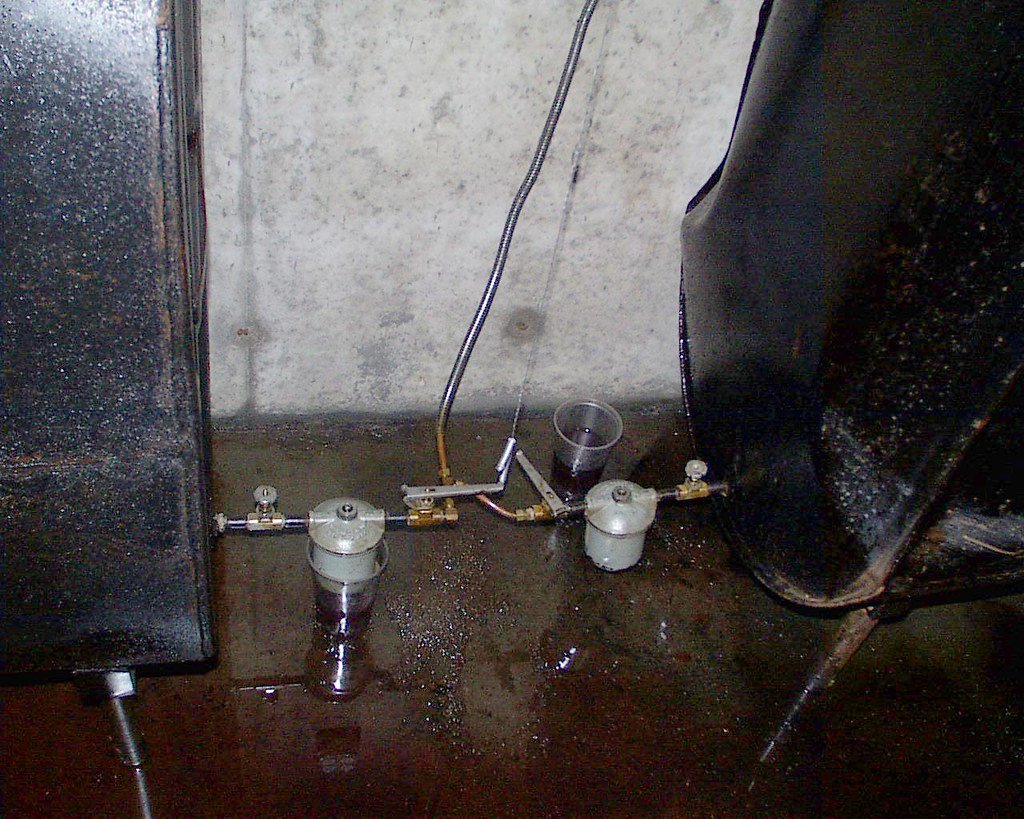
- Photo: “Rupture AST and Broken Filter and Delivery Line,” Massachusetts Department of Environmental Protection, CC BY 2.0, via Flickr.